Assassin’s Creed Shadows is the game we’ve all been whispering about at every Ubisoft Forward since 2010, asking, “When are we finally getting Japan?” Well, here we are. After nearly two decades of hopping rooftops from Jerusalem to Boston, to Paris, to the Viking Age, Ubisoft has finally dropped us into the middle of Sengoku-period Japan. There’s a lot to love, nitpick, and a few things that make you want to pull a Yasuke and smash a wall with your bare hands.
Right from the opening, it’s clear AC Shadows is in love with its setting. The world is amazingly realized, like someone on the devs’ team spent way too much time binge-watching Kurosawa films. The world has sprawling castles, misty mountains, and cherry blossoms with nice-to-see slow motion falls. In terms of stabbing, Assassin’s Creed has doubled down on its signature cocktail: stealth, parkour, and combat, sprinkled with a katana and served in a lacquerware cup.
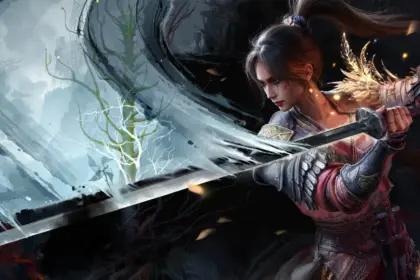
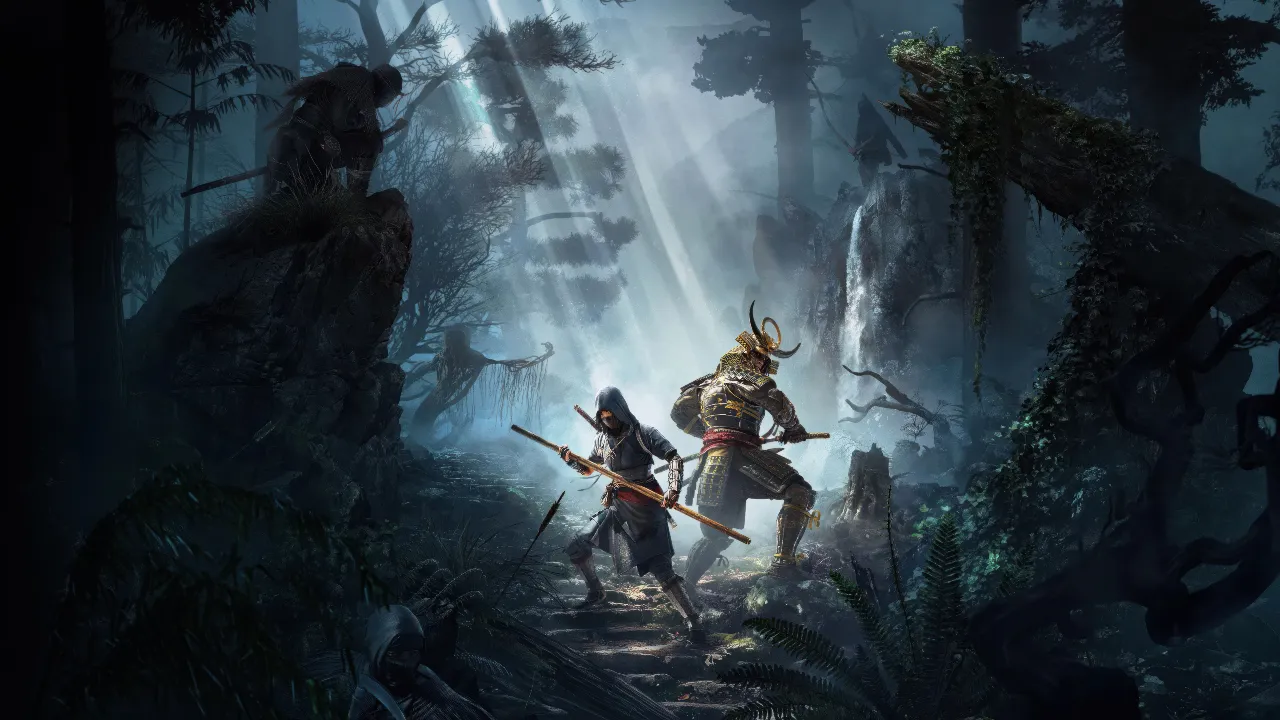
I’ve got to start with the stars of the show: Naoe and Yasuke. Naoe is the classic Assassin’s Creed ninja archetype who blends into shadows, turning invisible, parkouring over rooftops, and stealthily killing targets. Yasuke, on the other hand, is a samurai so hefty he probably causes a minor earthquake every time he takes a step. My first few hours were like Ubisoft had some crush on Naoe, given how much screen time and narrative focus she gets. Her story hits familiar notes like personal loss, revenge, hidden blade—check, check, check. But thanks to a solid performance from Masumi Tsunoda and emotional cutscenes (Ubisoft finally figured out cinematography), Naoe’s story never felt stale, even if it was trope heavy.
Yasuke looks to me like a buddy you accidentally bench in an RPG. His introduction is attractive—historic, weighty, and different—but for too long, he is kinda there, flexing in the background like “Hey, when do I get to do my thing?” When he finally does, though, it’s the same as someone swapped out your daggers for a kanabo the size of a telephone pole. Yasuke is a powerhouse in a fight, bulldozing through enemies, shrugging off blows, and leaving a trail of “oops”. But outside of fights, he struggles to climb, his stealth game is about as subtle as a fireworks show, and I swear the dude has a personal vendetta against tightropes.

What I truly loved in AC Shadows is the stealth mechanics that are far better this time than we have seen previously even in last year’s Assassin’s Creed Mirage. The old series fans will remember when stealth used to be about hiding in haystacks and praying no one saw you sprint across rooftops? Shadows takes it further. The new light and shadow system is brilliant where you don’t just crouch behind random crates anymore, but manipulate the environment in Shadows. Extinguish a lantern, slide prone under a floorboard, and wait for a guard to look the other way. Ubisoft took some notes from Splinter Cell before they forgot the series has existence. There’s even a visibility meter now, and thanks to that, you can feel a proper predator again instead of an assassin with plot armor.
But the stealth difficulty is a little bit of a rollercoaster. On lower difficulties, guards might as well be legally blind, but with the settings cranked up, they can spot you from a mile away because the wind nudged a blade of grass. I invested some time playing with the difficulty options before I ended up finding a sweet spot in the middle, but there were definitely moments where I thought, “Naoe could be a ghost if this game let her.”

The combat in AC Shadows is fantastic. Assassin’s Creed has always flirted with being a decent action game, but it often turns out Ubisoft couldn’t decide if it wanted to be Batman: Arkham or Dark Souls-lite. Though combat is meaty here. Blades clash, armor shatters, helmets fly off with great control, and Yasuke’s heavy-hitting samurai brawls are pure dopamine. He’s a one man wrecking crew, using swords, naginatas, and even guns to dismantle enemies who, for once, aren’t standing around waiting their turn to die. Meanwhile, Naoe is the scalpel to Yasuke’s hammer. She is frail, and fast, and if you try to Yasuke your way through a fight as Naoe, you’re gonna have a bad time.
What pulled me in, though, is how Ubisoft reined in the “map vomit” problem. Instead of a galaxy of icons begging you to pick flowers, collect trinkets, or chase feathers such as in AC II, Shadows trims the fat. Japan’s world is a checklist simulator and more like an invitation to explore. There are still activities such as hideouts to raid and castles to infiltrate but it’s not overwhelming. And when you do climb that trademark sync point and look out over the Japanese countryside, it feels earned.

One of the things I didn’t expect to appreciate as much as I did was the seasonal system. Ubisoft hyped it up in order to change how you approach missions, and it sort of does, but mostly in an “Oh cool, now it’s winter, and there’s snow” way. When the moats freeze over and I can scale a castle wall that would have been impossible in spring, I grin like a fool. But did it force me to rethink my strategy from the ground up? Not exactly. That being said, there’s a strange charm to riding through autumn forests under golden leaves or sneaking through a downpour at night where the lighting is only a chef’s kiss. Ubisoft’s art team needs a vacation and a raise, probably in that order.
While the world is beautiful, the RPG still looks stuck in Ubisoft’s post-Origins design language. Shadows dips one toe into RPG-lite territory but doesn’t fully commit to it. You have your skill trees for both protagonists, and while they’re streamlined compared to Valhalla’s star map, I couldn’t ignore the feeling that half the unlocks were only filler. For Naoe, expanding her shinobi toolkit with chain sickle grapples or smoke bomb upgrades is very meaningful. Yasuke’s tree, meanwhile, is similar to a buffet of “How would you like to murder this room full of guys today?”—kanabo slams, samurai parries, armor-piercing arrows, the works. The developers have struggled to balance his brute-force approach with Naoe’s finesse.
What does wear thin is the loot treadmill. After Mirage dialed back the RPG bloat, Shadows throws you back onto the hamster wheel of color-coded gear: Common, Uncommon, Epic, Legendary. There are some standout pieces, like Yasuke’s armor that lets him parry unblockables or Naoe’s kusarigama that turns enemies into environmental-killing rag dolls. But after 20 hours, I was drowning in tanto knives and swords I was never going to use. Ubisoft can’t help, this is one part where I was hoping they’d follow Mirage’s less-is-more philosophy, but in Shadows, you’re gonna hoard loot like it’s 2018 again.
The side content Ubisoft swears is more meaningful now but mostly comes down to “find target, stab target.” Assassinating corrupt warlords and shady merchants never gets old when you’re leaping off rooftops in the dead of night, but can become a little samey. There’s an entire web of factions that you systematically dismantle, which is satisfying in a Hitman-esque way at first, but with time, you’ve cleared your tenth castle or wiped out another shadowy conspiracy figure, you will find yourself going through the motions.

Assassin’s Creed Shadows’ storyline is serviceable, but outside of Naoe’s vendetta, there aren’t many moments that left me slack jawed. Yasuke’s narrative is somehow criminally undercooked given how much noise Ubisoft made about his inclusion. His journey as a Black samurai is historically great, but it’s mostly background dressing. He is the muscle to Naoe’s brains, and while that dynamic works well in gameplay, it leaves Yasuke the support character in his own tale.
The companions you bring together at your shinobi HQ (Ravensthorpe 2.0) don’t help much either. They’re fine, functional, but don’t expect BioWare level bonding moments. Most of them hand you missions and then fade into the background until you recruit the next one. Honestly, the most memorable side character I met was a guy, yokai, who dressed as a melon and fought people during a spring festival.
One thing Shadows absolutely nails is the way it makes you an actual assassin again. Ubisoft ditched the “icon explosion” of Origins and Odyssey in favor of a more deliberate clue system. Instead of giant neon signs pointing out every objective, you now get vague hints like “southwest of the village with red lanterns.” Even when I messed up and sent a scout (one of your limited reconnaissance resources) to the wrong area, it was the fun trial-and-error that reminded me of the franchise’s stealthier roots.

Combat difficulty also gets a much needed shot of adrenaline. Gone are the days of sleepwalking through 10 enemies as they wait their turn to swing. Enemies are aggressive, block more, and force you to think fast – I loved it. Playing as Yasuke gives you the strength to defeat groups of armored foes. Naoe, however, turns into a glass cannon—stealth goddess in the dark, but one wrong step in a daytime brawl is enough for you to be toast. This dichotomy keeps both playstyles unique, even if the balance tips slightly in Naoe’s favor due to how adaptable she is to the world.
Performance wise, the game runs solid. My PC isn’t the newest rig on the block (shoutout to my aging RTX 2080 Super), but Shadows mostly held steady at 50-60 fps on medium settings. No major crashes, just the occasional camera freakout during chaotic indoor fights. Given Ubisoft’s spotty track record with optimization, this was a welcome surprise.
Yet, despite all these improvements, Assassin’s Creed Shadows still drags along a few of the company’s usual open-world vices. Towns are busy with civilians, but you have minimal interaction with them. Guards still suffer from the signature “zone blindness” issue where they will lose interest if you step outside a restricted area. While there’s technically a wanted system, it barely impacts the world the way older AC games did when guards would continuously chase you down across cities. That said, when Shadows leans into its strengths—tight stealth, rewarding exploration, and satisfying combat—it’s some of the best the series has been in years. It won’t make non-believers fall in love right away with the franchise, but if you’re an AC veteran or someone who likes stabbing fools under the moonlight while rain soaks your cloak, this is your game to play.
Verdict
Assassin’s Creed Shadows is the series doing what it does best while trying (and mostly succeeding) to refine the formula. The return to focused stealth, meaningful exploration, and brutal melee combat is the perfect middle ground between Mirage’s back-to-basics approach and Valhalla’s RPG sprawl. Naoe and Yasuke make for an interesting, if unbalanced, duo that highlights two very different flavors of gameplay, and the Sengoku-era setting is a visual and thematic treat, even if the story plays it a little too safe. Sure, the role-playing systems are still bloated, loot is everywhere like confetti at a party you forgot you RSVP’d to, and the narrative in some areas gives the feel of a side dish rather than the main course. But when Shadows is doing fine, it’s Assassin’s Creed magic all over again.