

When historians look back at the golden age of real-time strategy, Age of Empires stands as the undisputed architecture of the genre. More than a game, it was the sacred blueprint that taught a generation of computer nerds how to hoard sheep, build walls, and hurl trebuchets across pristine digital isometric fields. But when the mid-2000s arrived, the RTS genre went virtually extinct, buried beneath the rise of MOBAs, battle royales, and endless cinematic third-person action games.
Enter Relic Entertainment and World’s Edge with Age of Empires IV. Coming off the identity-crisis-fueled wreckage of Dawn of War III (a game best left forgotten in the warp), Relic wisely realized that reinventing the wheel was a fool’s errand. Instead, they doubled down on pure, unadulterated nostalgia, crafting a love letter adjusted particularly to anyone who spent the last two decades nursing an Age of Empires II addiction.
High Middle Age Hoarding & Village Smash
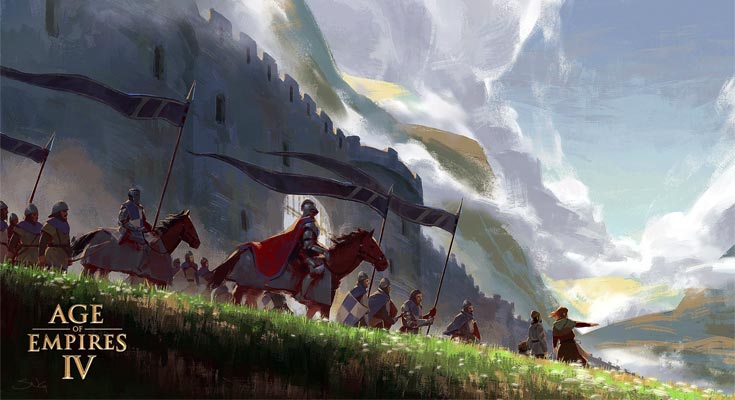
At its core, Age of Empires IV operates like the gaming equivalent of a lavishly wealthy grandparent spoiling you senseless. The game drowns you in historical campaigns, documentary-style production values, and an endless suite of multiplayer modes. Either you march the English longbowmen across muddy French fiefdoms or raid trade routes with feudal cavalry, the moment-to-moment loop remains amazingly untouched. You spawn villagers, assign them to chop wood and mine gold with frantic micro-management, construct barracks, and build a war machine that can flatten your neighbor’s village.
“It’s like reaching into the back of your cupboard for a favorite childhood snack and realizing it tastes just as crisp as you remembered—except now it’s served on silver tableware.”
What makes this safe return is its extraordinary attention to audio-visual feedback. Relic understood that for an RTS to be satisfactory, every single interaction needs weight. The thwack of an ax biting into timber, the metallic clatter of armor, and the resonant, bone-shaking THUD of a battering ram splintering a stone gate all sound punchy. Furthermore, the game gives control freaks total tactical freedom. You can turtle up behind fortified stone walls, build a glowing Wonder in the corner of the map, and dare the enemy to break your impenetrable defenses before the victory timer runs out. Or you can mass produce hundreds of cheap infantry, bypass their defenses, and drown their economy in a sea of steel before they even reach the Castle Age.
A Civilization for Every Playstyle
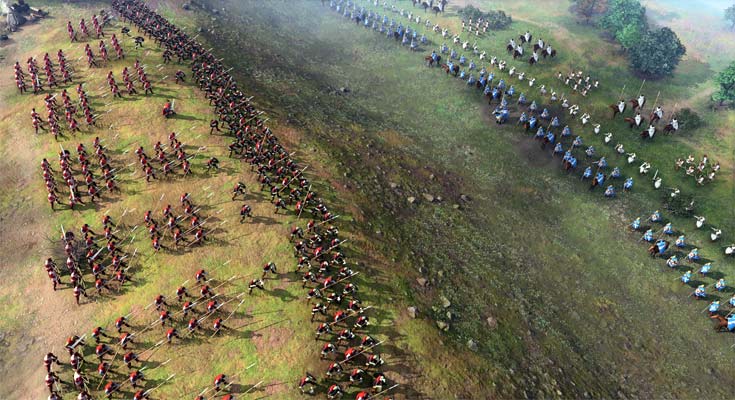
One highlight that keeps Age of Empires IV fresh is how the civilizations play differently on the battlefield. Either in its historical campaigns or intense Skirmish matches, Relic moved away from carbon-copy faction templates to build actual asymmetry. The English, French, Chinese, and Mongols return with refined mechanical tweaks, but the new additions—the Delhi Sultanate, the Holy Roman Empire, the Abbasid Dynasty, and the Rus—steal the show.
The Mongols can pack their entire city and migrate across the map on a whim, while the Rus field battle-hardened Warrior Monks that buff combat troops while capturing sacred sites. Then there’s the Delhi Sultanate, which brings terrifying, armored War Elephants to the party because nothing asserts military dominance काफी like a five-ton beast trampling an opponent’s infantry line into fine dust. Even if you stick with a more “boring” civ like the English, the visual evolution is fantastic; architecture, unit attire, and even regional dialects shift dynamically as you advance through the eras.
Starting in the Dark Ages with just a town center and a few villagers is one of my favorite parts of the game. These towns are small and fragile at first, and every decision could make or break you. Do you rush to gather food, or build up your defenses? This strategic anxiety is what I thrive on. Once your economy stabilizes, Skirmish mode unlocks a sandbox of custom map variables, resource tweaks, and AI difficulties, or you can go online to test your mettle against APM-god veterans who have been micro-managing worker paths since launch day.
History Class, But Make It Fun
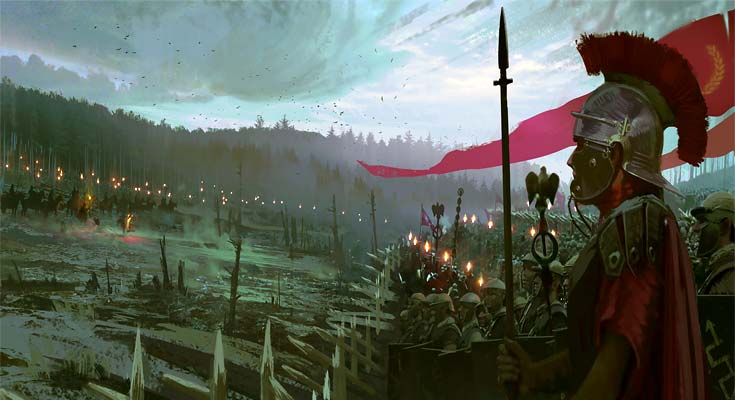
Age of Empires IV takes its history seriously, yet it never devolves into an uninspired classroom lecture. During the campaigns, a velvety narrator murmurs context at you like an ASMR podcast someone left running in the next room. You can skip the documentary interludes. I didn’t, because they hit the sweet spot of “wow, I’m absorbing history” with zero risk of a pop quiz. If you grew up getting the Normans and British history hammered into your skull until you could recite it in your sleep (hello, fellow survivors), the jump to the Rus principalities, the rise of Moscow, and Genghis Khan’s unstoppable steppes is a welcome change of pace. Finally, a syllabus I want to read.
Visually, it’s a treat. Zoom way out and watch a carpet of heavy cavalry sweep across a valley, and it’s stupidly satisfying; the next moment, zoom all the way in on one lonely villager by a lake, and the detail is worth praising. Pathfinding, though, can get awkward. When you try to squeeze a 200-population doomstack over one tiny bridge, you get medieval rush hour, complete with honking, minus the honking. My troops also struggled to hold the formation I’d told them to march in, and I’ll admit I have no room to judge. Fully conscious human soldiers would probably fail that test too. I’d fall apart on that bridge myself.
Verdict
Age of Empires 4 plays the classic formula almost by the book, and that’s fine. It only gets properly exciting when it wanders off the map the older games drew. The Mongols and the Russians are the reason I keep coming back. They don’t play like reskinned versions of everyone else, but they are people who woke up and chose chaos, and I respect that. The flaws are small, but I feel them. Unit caps hit sooner than I want, and pathfinding has moments where my army just stands there, blinking, like a group chat that can’t decide on a restaurant. And the graphics? For a 2021 release, I expected more. It’s fine. It’s a very nice, very serviceable pile of pixels.
Then a battle tips over at the last second, my heart rate does something illegal, and I forget every complaint I just made. The campaigns are huge and worth the time, too. I do wonder how this old favorite holds up now that other RTS games have been trying new things. Nostalgia only carries you so far, and I say that as someone who has spent hours on nostalgia alone. Still, more civilizations are coming, so I’d bet this thing has legs. Between the layered strategies and Skirmish, which never really ends, I’m not getting bored of it anytime soon. My social calendar is going to suffer, and I’m at peace with that.


