

Ubisoft Bordeaux’s Assassin’s Creed Mirage may follow Valhalla, but it represents a big shift in direction. Going against the grain, Ubisoft is taking Assassin’s Creed back to its roots with stealth, parkour, and good old-fashioned action-adventure, ditching the RPG things they’ve been doing lately.
By stripping away the level scaling and the complicated progression systems that made the game what it was for the past 5 years, Mirage is a major departure. Even though claimed to be a spin-off, it’s a concentrated distillation of the original Assassin’s Creed pillars. Based on its reception, AC Mirage could be the final farewell to RPG mechanics in the franchise as Ubisoft reconfigures what the series means.
This change of direction is a direct response to a growing sentiment that the series had lost its way. While the recent massive open-world titles were successful, the focus on grinding and statistics often diluted the core fantasy of being a surgical, silent killer. Mirage sends players back to stealth action and parkour, with elements of other games in the series. According to the developers, this isn’t just a side project, but a deliberate return to form.

Set two decades before the events of Valhalla, Assassin’s Creed Mirage follows Basim’s evolution from a common street thief to a master of the Hidden Ones. The setting is 9th-century Baghdad at its height—a dense city divided into four districts. While the industrial and garden sectors have been revealed, the entire map is built to promote stealth and parkour.
The world is more inhabited than recent entries. Players will visit the fortress of Alamut, the Assassin Order’s headquarters located in a remote valley, and encounter many historical figures as the story unfolds.
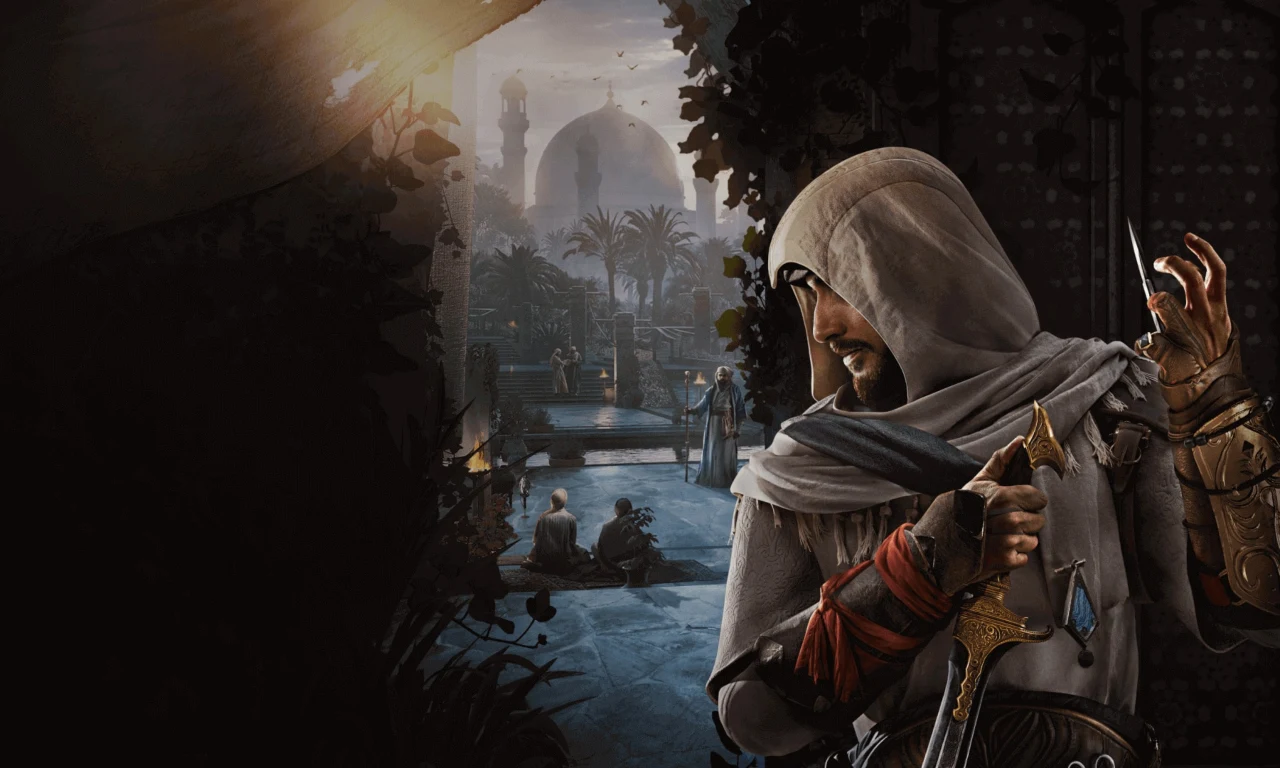
The story centers on Basim’s personal history, focusing on a tragic past haunted by visions of a Djinn. His journey is guided by Roshan, a former slave who rose through the ranks to become a top assassin and Basim’s mentor. Unlike the recent RPG games, Mirage shifts back to a narrative-driven play. The developers ditched character leveling and gear scores for a stealth system. To succeed, you gotta blend in, find the best entry points, and vanish after killing someone.
Basim’s toolkit reflects this shift. Players will have social stealth, can time-slow assassinations, and get new movement options like pole vault. Basim will also have a few side quests where he’ll remove minor targets, bribe guards, find clues, or eavesdrop on conversations to finish other objectives.
For tactical advantages, Basim can deploy gas mines and smoke bombs or summon Enkidu, his avian companion, to scout from heights. While tools can be upgraded throughout the game, the core focus remains on the player’s ability to journey through the environment unseen.