
Back in 2003, Prince of Persia: The Sands of Time completely ruined sleep schedules. That time-rewind mechanic made fixing a botched jump or a messy fight ridiculously satisfying. But then the mid-2000s came, and Ubisoft spent years trying to recapture that lightning in a bottle with sequels that just couldn’t quite hit the same high. By the 2010s? The franchise was basically dead in the water. Prince of Persia: The Lost Crown is the very oasis we’ve been waiting for years from the franchise. Instead of chasing modern AAA trends, it shrinks down into a 2D Metroidvania, a brilliant nod to the 1989 original that pays off big.
By shifting back to a 2.5D side scroller, it dodges the single worst thing about modern action games: terrible 3D camera angles that screw up your depth perception in tight quarters. The platforming is tight, and the game feel is unreal. Combat gives the full tough time, though fair warning—when the screen gets crowded with enemies, squeezing in your parkour combos gets too chaotic.
Right from the start of The Lost Crown, the game pulls the rug out from under you. You’re introduced to Sargon, a fast and dangerous young warrior whose mission is to rescue the actual Prince of Persia. Yep, you read that right — you’re not playing the prince. You’re playing the hero sent to save him, and things only get crazier when Sargon is betrayed by the very people he trusted: the Immortals. Before long, our hero is dumped into a massive hole, completely set up by some shady characters. Poor Sargon never even gets a chance to catch his breath.
What makes The Lost Crown immediately click, though, is that Sargon is not some helpless rookie. In a lot of Metroidvanias, you spend the opening hours slowly building your character, unlocking abilities and gradually becoming a strong force. Sargon is already an absolute menace. His speed, aggression, and mobility make him easy to control from the second you pick up the controller. And that speed is everything.
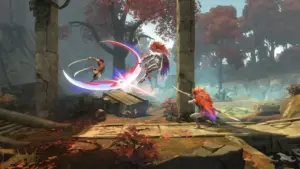
Combat in The Lost Crown can turn absolutely wild. Even basic enemies can punish you if you start button-mashing and switch your brain off. You have to watch their movements, react to attacks, and get your timing right. Dodge, counter, jump, and instantly getting back on the offensive becomes second nature. The best strategy is simple: keep moving. Sargon plays at his strongest when he flies across the screen, slicing through enemies and barely giving them a chance to breathe.
Even on the default difficulty, the game delivers some addictive combat. You’ll be thrown against skeletons, ghouls, monsters, and all kinds of nasty creatures. The battle is centered on perfect dodges, and I can guarantee it will keep you glued to your seat.
The boss fights are like a total riot of color and chaos, and they’re a challenge to play through. Even though some of the areas might give you a familiar sense, they’re still very well-designed. There are hidden shortcuts, secrets, stories, and unique items you can find in treasure chests. As you progress, you’ll find new roads and routes, like crossing a gigantic maze or a Swiss cheese warren. Around every corner, there’s something fresh.
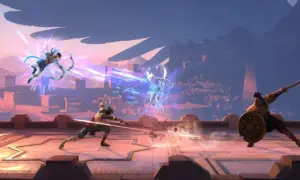
Prince of Persia: The Lost Crown presents 20+ hours of slick platforming puzzles on standard difficulty alone, with the exact top-tier environmental design you’d expect from the team behind Rayman Legends. Working around Sargon’s kit scratched every itch I had for hyper-mobile air combat. Once you chain wall jumps, air dashes, and grappling, you feel completely unstoppable.
The time powers are where the movement mechanics are the best. You can warp ahead, drop a shadow marker to snap back to mid-air, or rewrite a bad sequence completely. Ubisoft Montpellier uses these tools to build some highly clever room-scale puzzles. If you push the difficulty up, the game gets mean, demanding frame-perfect execution. Flip the switch the other way, though, and the accessibility toggles let anyone tune the friction to fit their playstyle.
The smartest feature in the package has to be the Memory Shard system. Click down on the D-Pad, and the game pins a screenshot directly to your mini-map at your exact location. The game makes it easy as pie to keep track of everything with its ability to tag puzzles, valuables, or even routes you haven’t got the skills to cross. No more scribbling notes on a notepad or trying to remember which blocked path needs a late game upgrade; it completely fixes Metroidvania backtracking fatigue.
My main gripe comes down to the narrative payout. The main campaign wraps up while leaving several huge threads dangling in the wind. Unless you dig into the late-game platforming challenges and hunt down every collectible item for a 100% completion, the story seems half-finished by the time the credits roll.
Gareth Coker and Mentrix cooked with this soundtrack. The music bangs, and Navid Negahban brings weight to Sargon—dude actually cares about his performance. Then you encounter this one side NPC that sounds like Siri reading a grocery list. Turns out Ubisoft straight-up used a generic text-to-speech generator for the lines. They claim a real actor will patch it in later, but launching a full price game with stock AI voice clips is just lazy.
The Lost Crown also included a multiplayer mode for the fans. The ability to form squads and take on challenges together or compete toe-to-toe is something everyone loves to see in the game.
However, the performance doesn’t seem perfect in our gameplay. There are a few stutters when entering new locations (fortunately, these transitions never feature gameplay, so the jitters are short and minimal), and there were a few problems in non-transitional cutscenes as well. If you play on Switch, expect a few extra load screens, but the port runs surprisingly well on handheld. The cutscenes are not impressive either. Visually, the game holds up well from a distance, but the character models lose some luster during close-up story sequences, where a lack of texture and lackluster facial expressions become apparent.
Verdict
Prince of Persia: The Lost Crown is a triumphant return to form, successfully revitalizing a dormant franchise through masterclass platforming and visceral, high-speed combat. By leaning into its 2.5D roots, Ubisoft Montpellier has developed a Metroidvania that’s nostalgic and refreshingly modern, bolstered by an ingenious Memory Shard system that sets a new standard for genre quality-of-life features. While the experience is occasionally hampered by a disjointed narrative conclusion, some lackluster character modeling, and an egregious reliance on placeholder AI voice acting for side characters, these flaws are overshadowed by the game’s strong mechanical polish.